Free app for Mac

Health breaks that walk across your screen

At the pace you choose, a little character strolls across your desktop holding balloons. Each balloon is one small habit: drink a glass of water, look into the distance, walk for a few minutes, climb a flight of stairs. Pop it once it’s done, and off it goes. How often each balloon comes, your hours, days, character and sounds: everything is adjustable.

  • Drink a glass of water
  • Look into the distance
  • Walk for 3 to 5 minutes
  • Climb some stairs
  • Clicka balloon to pop it.
  • Right-clickthe character for “later”: it comes back with the same balloons.
  • Double-clickit once every balloon is popped: it hurries off.
  • Soundis on, as in the app. You can change that later.
Download re•set Free · macOS 13 Ventura or later · 7 languages

Four habits

One balloon per habit, nothing more

No dashboard, no score, no streak to keep alive. Four colours for four habits that public health guidelines recommend repeating throughout the day. The frequencies below are the defaults; each one can be changed, and any balloon can be switched off.

Water

Default: every hour

One glass, 200 to 250 ml (about 8 fl oz). Over a working day, that covers most of what you need to drink.

Eyes

Default: every visit

Look at something 20 feet (6 m) away or more for at least 20 seconds, or close your eyes for a moment.

Walk

Default: every 30 minutes

Stand up and walk at an easy pace. Of the four, this is the one that matters most against long hours of sitting.

Stairs

Default: every 2 hours

One to three trips: go up briskly, come down slowly holding the handrail.

Your day, balloon by balloon

Example with one shared interval, 9 am to 6 pm at fixed times. In the app, each balloon can also have its own frequency.

This is the rule the app uses: each balloon takes the largest multiple of your interval that doesn’t exceed its recommended frequency. When the interval is too long, the balloon says so, just as in the settings.

The app

Discreet, adjustable, and always in the menu bar

re•set has no Dock icon. It lives at the top of your screen, next to the clock, and only shows up when a visit is due. The rest of the time, it does nothing at all.

re•set
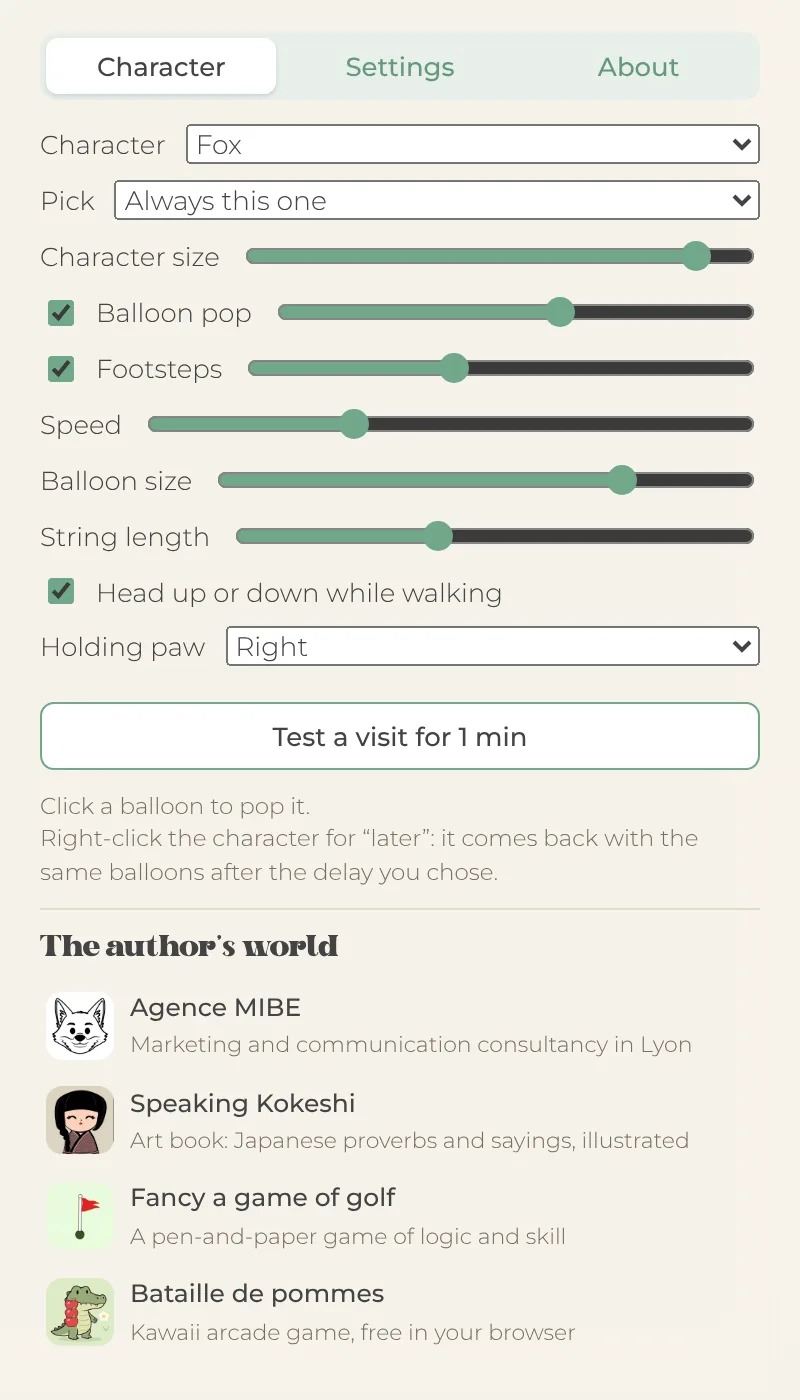
Character tab of the re•set settings

The three settings tabs, as they appear in the app.

The menu bar icon

A small balloon next to the clock. It shows how many balloons you have popped during the current visit. Its menu tells you when the next visit is due and which balloons it brings, opens the settings, runs a one-minute test, and turns reminders off with one click.

A character that suits you

Pick a character: always the same one, a random one each day, or a new one at every visit. Its size, its speed, the size of the balloons and the length of the strings are all adjustable. Footsteps and balloon pops each have their own volume, or can be switched off.

Your rhythm, not its own

You choose the active days, one continuous block or a morning and an afternoon, and how often balloons come: one shared interval (15 minutes to 1 hour) or a separate frequency for each balloon (15 minutes to 3 hours). Any balloon can also be switched off. The rhythm can follow fixed times, start when your Mac starts, or reset each time you pop the walk or stairs balloon.

Away for more than 30 minutes, or Mac asleep? The character leaves after 5 minutes, and nothing piles up for when you get back.

Video calls, full screen, discretion

When your camera is on, re•set pauses itself: nobody on the call will see a crocodile stroll across your shared screen. Full-screen apps, such as films or presentations, are left alone by default. Right-click the character to send it away “later”: it returns with the same balloons after 5, 10 or 15 minutes.

Seven languages

The app follows your Mac’s language, or the one you choose in the settings.

  • Français
  • English
  • Deutsch
  • Español
  • Italiano
  • 日本語
  • 한국어

The characters

Twenty-four characters, all original

They were first drawn for Bataille de pommes (Apple Battle), my kawaii arcade game, before finding a second life here. Each one walks sideways, towards you and away from you, turns its head and looks up at its balloons.

Why balloons? Because a balloon is lighter than a notification. It doesn’t feel like corporate software calling you to order, and popping it is genuinely satisfying.

Click a character to see it in the demo.

The story

Why I made re•set

I’m an illustrator, a marketing consultant and a web developer. In practice, that means I spend most of my days in front of a computer.

I know the tunnel well: you open a file, fix one detail, then another, and three hours later you look up, still in the same position, eyes dry, without having had a glass of water. I knew I should move more often. I didn’t, for lack of a cue that was neither an alarm nor one more thing to feel guilty about.

So I drew that cue. I wanted something playful, that never gets in the way, and that helps me build a steady routine rather than make the odd heroic effort.

The re•set crocodile hanging from a heart-shaped balloon

Who re•set is for

Anyone who works sitting at a screen

Designers, developers, writers, accountants, students: every day when you forget to stand up.

Remote workers

At home there is no coffee machine and no colleague to break up the morning. The natural breaks disappear.

People who forget to drink

The glass next to the keyboard is still full at lunchtime. The blue balloon comes by every hour.

People whose eyes are tired by evening

The cream balloon reminds you to look into the distance, regularly, even in the middle of something absorbing.

What the research says

Why these four habits, and how often

Every default setting in re•set comes from an official guideline or a published study. Here they are, limits included, because none of them is perfect.

Water

Drinking regularly

The guideline

The European Food Safety Authority (EFSA) sets an adequate intake of 2.5 litres of water a day for men and 2 litres for women, food included. Drinks provide about 80% of it, so roughly 2 litres and 1.6 litres to drink.1 US reference values from the Institute of Medicine are higher, at 3.7 and 2.7 litres of total water.26

Why

A meta-analysis of 33 studies found that even mild dehydration mainly affects attention, executive function and coordination. The effect is small below a 2% loss of body weight and clearer beyond it.2

Those studies often involve heat or exercise. At a desk, the risk is simpler: forgetting to drink for hours.

In re•set

One 200 to 250 ml glass every hour. Over an eight-hour day, that adds up to 1.6 to 2 litres, which is what EFSA suggests drinking.
Eyes

Resting your eyes

The guideline

The so-called 20-20-20 rule: every 20 minutes, look at something at least 20 feet (6 m) away for at least 20 seconds.3

Why

Focusing on a nearby screen for long periods tires the eyes: dryness, irritation, blurry vision by the end of the day. In a study at Aston University, 29 computer users received break reminders based on this rule for two weeks. Their eye strain and dry eye symptoms decreased, then came back a week after the reminders stopped.3

Another study, using a 40-minute reading task, found no benefit from 20-second breaks.4 The exact numbers are still debated. What stands out is that regularity matters: the benefit lasts as long as the habit does.

In re•set

An eyes balloon at every visit. With the default 30-minute interval, that is a little less frequent than the rule, and the app tells you so. You can set this balloon to 20 minutes.

Walk

Breaking up sitting

The guideline

In October 2025, France’s health and safety agency ANSES updated its advice: walk for 5 minutes every 30 minutes, at a light to moderate pace. In 2016 it recommended a break every 90 to 120 minutes.6

Why

At Columbia University, 11 adults sat for eight hours while testing several walking schedules. Only 5 minutes every 30 minutes lowered both blood sugar and blood pressure. The blood sugar spike after a large meal dropped by 58%. Walking once an hour made no difference to blood sugar.5

The same participants felt less tired and in a better mood. None of the schedules changed their cognitive performance, for better or worse.5

An analysis of more than a million people found that 60 to 75 minutes of moderate activity a day cancels out the higher death rate linked to sitting more than 8 hours.7 Few people reach that level. Breaking up sitting is no substitute for exercise, but it is what remains possible in the middle of a working day.

In re•set

A walk balloon at every visit, every 30 minutes by default. Three to five minutes is enough: fetch some water, walk around the room, take a phone call standing up.

Stairs

Climbing a few steps

The guideline

There is no official guideline for stairs as such. Researchers talk about “exercise snacks”: short, vigorous climbs spread across the day.8

Why

Inactive adults briskly climbed a 60-step staircase three times a day, one to four hours apart, three days a week. After six weeks, their cardiorespiratory fitness had improved, modestly but measurably.8

In a large wearable-tracker study of 25,241 people who did no exercise, about three short bursts of vigorous activity of 1 to 2 minutes a day were linked to a 38 to 40% lower risk of death, and 48 to 49% lower for cardiovascular death.9 That is an association, not proof of cause and effect.

In re•set

A stairs balloon every two hours, three or four a day. Go up briskly, come down slowly holding the handrail. If you have been inactive for a long time, or have a health condition, check with a doctor first.

Focus

Doesn’t it break your concentration?

It was the first question people asked me, and it is a fair one: every interruption has a cost. Here is what the research says, separating what is solid from what is less so.

What is well established

Several studies agree.

  • Less fatigue. Micro-breaks of under 10 minutes slightly boost how energetic people feel and reduce fatigue, according to a meta-analysis of 22 studies.10 Field studies by the US occupational health institute (NIOSH) on screen work point the same way: added short breaks reduce discomfort and eye strain.21
  • No loss of productivity. In those same field studies, adding short, frequent breaks did not lower output, despite the time taken away from work.21
  • More ideas on foot. Walking boosts divergent thinking, the kind that produces ideas: about 60% more in the Stanford experiments,12 and a large effect according to a 2026 meta-analysis.22

What is less clear

Mixed results, or still little studied.

  • Raw performance. Overall, the effect of micro-breaks is not significant; it shows up mainly on less demanding tasks.10 In the field, one site gained productivity and the other did not.21 In the lab, two brief diversions were enough to prevent the drop in attention over a 50-minute task.23
  • Cognition. Active breaks neither improved nor harmed it in the Columbia study.5 Reviews find mixed results, depending on the type, frequency and intensity of the break.24
  • The kind of thinking. Walking helps you come up with ideas, not solve a problem that has only one right answer.1222

Timing matters

  • An interruption in the middle of an action is costly: people make up for it by working faster, under more stress.11
  • The same interruption at the end of a step (an email sent, a file saved) is far less disruptive: less frustration, faster recovery.25
  • That is how re•set works: the balloon waits. You pop it when you reach the end of a step, and a right-click sends the character away until later.
  • It never takes focus: you keep typing while it walks by. It hides during video calls and leaves full-screen apps alone.

The approach

Move a little, but all the time

re•set started from a personal belief, which I wanted to test against the facts. Some intuitions hold up very well. Others need nuance.

A sound mind in a sound body

The phrase comes from the Roman poet Juvenal. In the original it is a wish: one should pray for a sound mind in a sound body. Two thousand years later the idea still holds: body and mind don’t rest separately.

Regularity before intensity

This is the best-supported point. Walking once an hour does nothing for blood sugar; every 30 minutes does.5 ANSES sees benefits when sitting is broken up regularly, ideally every 30 minutes.6 A little, often, beats a lot, rarely.

The tunnel

In France, 28% of adults say they sit for more than 7 hours a day, and over 40% among managers and 18 to 29 year olds.13 Almost everyone knows they should get up regularly. The problem isn’t knowing; it’s remembering when you are absorbed in something.

Thinking on your feet

I think better standing up, and I take phone calls walking around. It’s not just a feeling: walking boosts divergent thinking, the kind that produces ideas, during the walk and just after.12 Getting up mid-task isn’t always lost time; sometimes that’s when the answer turns up.

Factory breaks, a century ago

In the 1920s, Britain’s Industrial Fatigue Research Board studied breaks in factories. Its investigations concluded that they made workers more content and often raised output.14 At the same time, at Western Electric’s Hawthorne Works near Chicago, women assembling telephone relays tried out several schedules. Two 5-minute breaks, then two 10-minute breaks, raised output. Six 5-minute breaks lowered it: there were too many, and they broke the rhythm of the work.20

These results have been debated since, as the attention paid to the workers may have mattered as much as the breaks. But the lesson still stands: a break helps, too many breaks get in the way. That is why re•set lets you set how often each balloon comes and send the character away until later.

Blue zones: connection and movement

Sardinia, Okinawa, Nicoya, Ikaria: in these regions, demographers found an unusually high share of very old people. In Sardinia and Nicoya, ages were checked record by record against civil registers, and the researchers behind the concept set out those checks again in 2025, in response to critics.16 Demographer Saul Justin Newman questions the reliability of extreme-age data in general.15 The debate is still open. And the advantage seems to be fading in younger generations: in Nicoya, it disappears for men born after 1930.17

What holds up, whatever the outcome of that controversy, are two traits these regions share. Social connection first: across 148 studies, strong social relationships raised the odds of survival by 50%, an effect comparable to well-known risk factors.18 Then light but constant activity, such as gardening, walking or housework: measured with wearable trackers, any physical activity, even light, is linked to lower mortality.19 re•set can’t help with the first. It helps a little with the second.

re•set icon, a heart-shaped balloon

Download re•set

Free, no account, no ads. The app runs entirely on your Mac and collects no data.

Download for macOS
  • macOS 13 Ventura or later
  • Version 1.0, November 2026
  • English, French, German, Spanish, Italian, Japanese, Korean

FAQ

Frequently asked questions

Yes. No subscription, no account, no ads. The licence forbids selling, renting or redistributing it for payment.

re•set runs on macOS 13 Ventura and every later version.

Not by default. As soon as your Mac’s camera is in use, re•set pauses and says so in its menu. You can turn this off in the settings.

By default, re•set does not appear over full-screen apps. An option lets you allow it.

After 30 minutes without keyboard or mouse activity, or 30 minutes of sleep, the character leaves after 5 minutes. Nothing piles up for your return: the rhythm starts again from zero.

No. To know whether you are there, it only checks how long it has been since your last keyboard or mouse action, a value macOS already keeps. No permission is requested and no keystrokes are read.

No. The app runs entirely on your computer. It does not collect, transmit or sell any data.

Once a day, just before noon, the character may come by with a balloon in the colours of another of the author’s projects. It doesn’t count towards your reminders, and popping it opens nothing.

No. The reminders are for information and help you build habits. If you have a health concern, talk to your doctor.

Sources

References

The figures on this page come from these publications. Links point to the abstracts or official texts.

  1. EFSA, groupe NDA. Scientific Opinion on Dietary Reference Values for water. EFSA Journal, 2010, 8(3):1459. efsa.europa.eu
  2. Wittbrodt M. T., Millard-Stafford M. Dehydration Impairs Cognitive Performance: A Meta-analysis. Medicine & Science in Sports & Exercise, 2018, 50(11):2360. PubMed
  3. Talens-Estarelles C. et al. The effects of breaks on digital eye strain, dry eye and binocular vision: Testing the 20-20-20 rule. Contact Lens and Anterior Eye, 2023, 46(2):101744. doi.org/10.1016/j.clae.2022.101744
  4. Johnson S., Rosenfield M. 20-20-20 Rule: Are These Numbers Justified? Optometry and Vision Science, 2023, 100(1):52-56. PubMed
  5. Duran A. T., Diaz K. M. et al. Breaking Up Prolonged Sitting to Improve Cardiometabolic Risk: Dose-Response Analysis of a Randomized Crossover Trial. Medicine & Science in Sports & Exercise, 2023, 55(5). PubMed ; Columbia University press release, EurekAlert
  6. ANSES (French Agency for Food, Environmental and Occupational Health & Safety). Marcher 5 minutes toutes les 30 minutes pour préserver sa santé (Walk 5 minutes every 30 minutes to protect your health), 8 October 2025. anses.fr
  7. Ekelund U. et al. Does physical activity attenuate, or even eliminate, the detrimental association of sitting time with mortality? The Lancet, 2016, 388:1302-1310. doi.org/10.1016/S0140-6736(16)30370-1
  8. Jenkins E. M. et al. Do stair climbing exercise “snacks” improve cardiorespiratory fitness? Applied Physiology, Nutrition, and Metabolism, 2019, 44(6):681-684. doi.org/10.1139/apnm-2018-0675
  9. Stamatakis E. et al. Association of wearable device-measured vigorous intermittent lifestyle physical activity with mortality. Nature Medicine, 2022, 28:2521-2529. doi.org/10.1038/s41591-022-02100-x
  10. Albulescu P. et al. “Give me a break!” A systematic review and meta-analysis on the efficacy of micro-breaks for increasing well-being and performance. PLOS ONE, 2022, 17(8):e0272460. doi.org/10.1371/journal.pone.0272460
  11. Mark G., Gudith D., Klocke U. The cost of interrupted work: more speed and stress. CHI 2008, p. 107-110. ics.uci.edu
  12. Oppezzo M., Schwartz D. L. Give your ideas some legs: The positive effect of walking on creative thinking. Journal of Experimental Psychology: Learning, Memory, and Cognition, 2014, 40(4):1142-1152. Stanford News
  13. Santé publique France. Sédentarité : prévalence et connaissance des recommandations (Sedentary behaviour: prevalence and awareness of guidelines), Health Barometer 2024. santepubliquefrance.fr
  14. Industrial Fatigue Research Board (Medical Research Council). Wyatt S. Rest-pauses in industry: a review of the results obtained. London, HMSO, 1927. Wellcome Collection; summary of the 1925 annual report: Industrial Fatigue, AIME, 1927. onemine.org
  15. Popular Science. Do people in blue zones actually live longer? On Saul Justin Newman’s work and the blue zone researchers’ response. popsci.com
  16. Austad S. N., Pes G. M. The validity of Blue Zones demography: a response to critiques. The Gerontologist, 2025, 65(12):gnaf246. academic.oup.com; see also Poulain M. et al. Identification of a geographic area characterized by extreme longevity in the Sardinia island: the AKEA study. Experimental Gerontology, 2004, 39(9):1423-1429. doi.org/10.1016/j.exger.2004.06.016
  17. Rosero-Bixby L. The vanishing advantage of longevity in Nicoya, Costa Rica: A cohort shift. Demographic Research, 2023, 49(27):723-736. demographic-research.org
  18. Holt-Lunstad J., Smith T. B., Layton J. B. Social relationships and mortality risk: a meta-analytic review. PLOS Medicine, 2010, 7(7):e1000316. doi.org/10.1371/journal.pmed.1000316
  19. Ekelund U. et al. Dose-response associations between accelerometry measured physical activity and sedentary time and all cause mortality: systematic review and harmonised meta-analysis. BMJ, 2019, 366:l4570. doi.org/10.1136/bmj.l4570
  20. Roethlisberger F. J., Dickson W. J. Management and the Worker. Harvard University Press, 1939 (relay assembly test room experiments, Hawthorne Works, 1927-1932). Overviews: SAGE Encyclopedia of Organization; Wikipedia, Hawthorne effect
  21. NIOSH field studies on breaks in screen work: Galinsky T. et al. Supplementary breaks and stretching exercises for data entry operators: a follow-up field study. American Journal of Industrial Medicine, 2007, 50:519-527. CDC Stacks; McLean L. et al. Computer terminal work and the benefit of microbreaks. Applied Ergonomics, 2001, 32:225-237. PubMed; Henning R. A. et al. Frequent short rest breaks from computer work: effects on productivity and well-being at two field sites. Ergonomics, 1997, 40(1):78-91. doi.org/10.1080/001401397188396
  22. Thabane A. et al. The impact of walking on creative thinking: A systematic review and meta-analysis. PLOS ONE, 2026, 21(5). doi.org/10.1371/journal.pone.0347878; Rominger C. et al. Acute and chronic physical activity increases creative ideation performance: a systematic review and multilevel meta-analysis. Sports Medicine Open, 2022. doi.org/10.1186/s40798-022-00444-9
  23. Ariga A., Lleras A. Brief and rare mental “breaks” keep you focused: deactivation and reactivation of task goals preempt vigilance decrements. Cognition, 2011, 118(3):439-443. PubMed
  24. Chueh T.-Y. et al. Acute effect of breaking up prolonged sitting on cognition: a systematic review. BMJ Open, 2022, 12(3):e050458. PubMed Central; BAuA. Evaluating the methods used to examine sitting breaks and their influence on mental load, physical strain, and cognitive performance. Frontiers in Physiology, 2026. doi.org/10.3389/fphys.2026.1755356
  25. Iqbal S. T., Bailey B. P. Effects of intelligent notification management on users and their tasks. CHI 2008. interruptions.net; Powers S. A., Scerbo M. W. Examining the effect of interruptions at different breakpoints and frequencies within a task. Human Factors, 2023, 65(1):22-36.
  26. Adequate intakes for total water compared: EFSA (2.5 L for men, 2.0 L for women) and the US Institute of Medicine (3.7 L and 2.7 L), as set out in a study of drinking water intake and diet quality in French adults. PubMed Central, PMC5133077